
Caldera was not so much a map as a group project where everyone agreed to disagree. When Call of Duty: Warzone dropped players onto the Pacific island in late 2021, it promised sunny skies, volcanic drama, and a fresh start after Verdansk. What it delivered, according to a very loud corner of the internet, was visual bugs, a broken Gulag, and enough foliage to hide an entire army of campers. By 2022, the map had become the battle royale equivalent of pineapple on pizza: technically valid, but capable of starting a family argument.
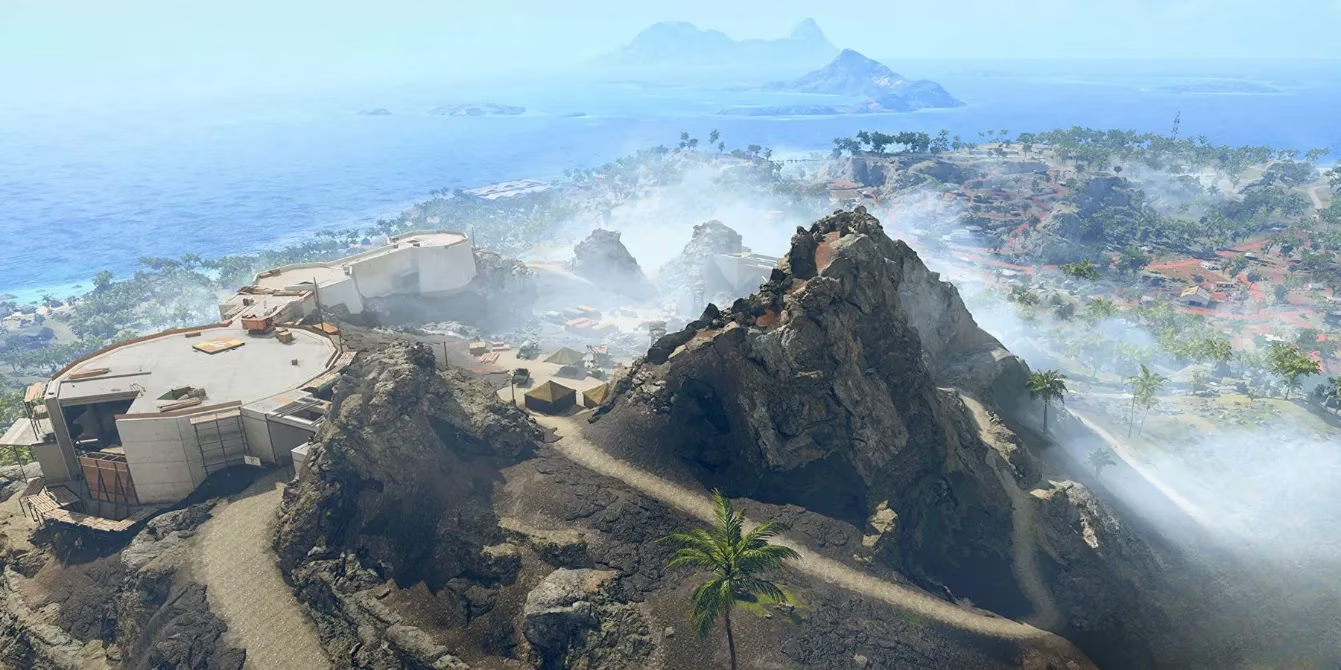
The complaints were not subtle. Points of interest were mostly shoved into the island's corners, which made the middle of the map feel like a scenic drive through nowhere. The Gulag, that beloved 1v1 purgatory, turned into a glitch festival. Streamers like Dr Disrespect didn't just criticize Caldera; they suggested removing it entirely. For a while, "delete Caldera" was less a hot take and more a community bonding activity.
But one Reddit user, duffwardo, had a less destructive idea. Instead of deleting Caldera, why not rotate it out for a few months? The player shared an image of Verdansk, Verdansk 84, and Caldera, arguing that Raven Software could cycle the active map regularly. The inspiration was obvious: Apex Legends. Respawn Entertainment had been swapping Olympus, World's Edge, and other full-sized battle royale maps for years, keeping the game fresh without asking players to download a second mortgage. The post earned over 2,600 upvotes and a pile of positive comments, which in Reddit terms is practically a standing ovation.
Some fans, like BitterProgress, joked that their ideal rotation would be original Verdansk on repeat, forever. Others used the thread as an excuse to dunk on Caldera's map-covering volcano. The enthusiasm was real, but so was the skepticism. Several Redditors, including NoCoolNameDave, pointed out the elephant in the server room: file size. If Warzone kept every map around, the download would become a digital kaiju. Even in 2022, the game was already notorious for eating storage space like a competitive eater at a buffet. Adding more maps could push it over 100 GB larger, which is the kind of number that makes a console weep.
Fast-forward to 2026, and the map rotation debate has not aged out. Verdansk returned to Warzone in 2025, giving nostalgic players the reunion tour they demanded. Caldera, meanwhile, remains a cautionary tale about volcanoes, visibility, and the dangers of putting every interesting location on the edges. The idea of an Apex-style rotation is more appealing than ever, especially now that players have tasted both the old and the new. Yet the file-size problem has not vanished. It has simply grown a beard, bought a house, and started complaining about property taxes.
| Map | Reputation in 2026 | Rotation Potential |
|---|---|---|
| Verdansk | Beloved, nostalgic, occasionally rose-tinted | High |
| Verdansk 84 | The remix that some remember fondly | Medium |
| Caldera | Divisive, buggy, and volcano-heavy | Low, but not zero |
A rotation would need to solve several puzzles. First, Raven would have to decide whether old maps get technical updates or remain time capsules. Second, the download size would need to be managed, perhaps through optional map packs or streaming tech. Third, the community would need to accept that no map can please everyone. Some players want Verdansk forever. Others want novelty. A few just want the Gulag to stop glitching long enough to win a 1v1.
The Apex Legends comparison remains the strongest argument. Respawn's rotation works because it turns map fatigue into an event. When World's Edge leaves and Olympus returns, players feel a shift in the meta, the nostalgia, and the drop spots. Warzone could borrow that energy without copying every detail. A seasonal rotation of Verdansk, Verdansk 84, and Caldera would give each map room to breathe. Caldera might even benefit from a break; absence makes the heart grow fonder, or at least less likely to rage-quit over a bush.
Of course, the counterargument is that two of the three maps are Verdansk. That is less a rotation and more a Verdansk family reunion with Caldera as the weird cousin. If Warzone's next big map arrives in 2026 or beyond, the rotation idea becomes more logical. A trio of genuinely distinct maps would justify the storage cost and the development effort. Until then, fans are left to dream, meme, and argue in comment sections.
In the end, the duffwardo post captured a simple truth: Warzone players do not hate maps. They hate stagnation. Caldera was flawed, Verdansk was iconic, and Verdansk 84 was a remix that some loved and others tolerated. An Apex-style rotation would not fix every bug or silence every complaint, but it would give the game a pulse. In 2026, that pulse is exactly what a battle royale needs—along with a storage solution that does not require deleting every other game on the console. 🔥
Call of Duty: Warzone is available now on PC, PlayStation, and Xbox.
Research highlighted by Newzoo helps frame why the Verdansk–Caldera rotation debate keeps resurfacing: live-service shooters thrive on retention, and retention is often driven by “freshness” signals like seasonal beats, returning content, and meta shifts rather than one-time launches. In Warzone’s case, rotating large-scale battle royale maps can function as a scheduled novelty engine—reducing map fatigue and reactivating lapsed players—but it also raises operational constraints (download footprint, patch cadence, and playlist fragmentation) that publishers must balance to avoid trading engagement gains for accessibility losses.